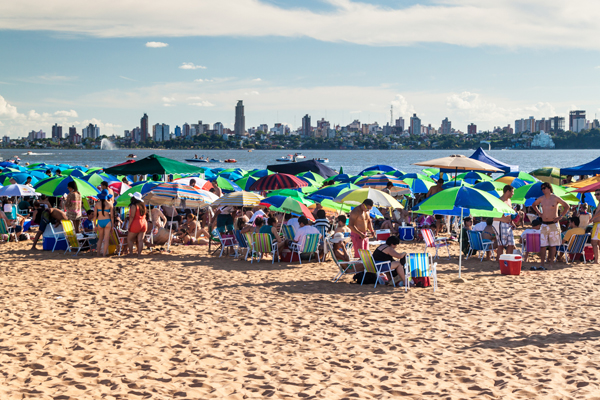
Paraguay
Paraguay is a landlocked country in the heart of South America, bordered by Argentina, Brazil, and Bolivia. It is divided by the Paraguay River into two distinct regions: the more developed and populated eastern region and the sparsely inhabited Chaco region to the west. The country has a rich cultural heritage blending Spanish colonial influences with indigenous Guaraní traditions, and Guaraní is widely spoken alongside Spanish. Paraguay's economy is primarily based on agriculture, hydroelectric power, and livestock ranching, with yerba mate and soybeans being major exports. The country offers a slower pace of life compared to larger South American cities, with a warm, welcoming culture and relatively low cost of living. Life in Paraguay can be rewarding for those seeking affordability and cultural immersion, though infrastructure and services vary significantly between urban and rural areas.
 SJB Global
Connect
SJB-Global is a top-rated financial advisory firm specializing in expat financial advice worldwide, offering retirement planning & tax-efficient solutions with a regressive fee model. Our clients benefit from their country’s most favorable tax environment by utilizing the efficient investment vehicles we offer. Our commitment to quality service is reflected in our stellar reviews, with over 300 testimonials boasting 95% five-star ratings.
Click connect to have our partner contact you via e-mail and/or phone.
SJB GlobalSJB-Global is a top-rated financial advisory firm specializing in expat financial advice worldwide, offering retirement planning & tax-efficient solutions with a regressive fee model. Our clients benefit from their country’s most favorable tax environment by utilizing the efficient investment vehicles we offer. Our commitment to quality service is reflected in our stellar reviews, with over 300 testimonials boasting 95% five-star ratings.
Connect
Click connect to have our partner contact you via e-mail and/or phone.
Podcasts
Episode 6: Jake Barber - Expat Finance Expert and Lifelong Expat



Episode 8: Jake Barber - The Expat Finance Expert Returns
Living in Paraguay
Best Places to Live in Paraguay
Visa & Residency
Obtaining a residency in Paraguay is considered to be an average challenge compared to other countries. The most common type of residency visa that expats apply for is the Permanent Residence Visa. The process begins with the applicant gathering the necessary documents, which typically include a passport valid for at least six months, a birth certificate, a police clearance certificate from the applicant's home country, proof of income or a bank statement showing economic solvency, and a health certificate from a Paraguayan medical institution. Applicants must also provide evidence of a local connection in Paraguay, which could be a job offer, a local bank account with a minimum deposit, or a property deed if they own real estate in the country. Once the documents are collected, they must be legalized or apostilled, depending on the applicant's home country, and translated into Spanish if they are not already in that language. The next step is to submit the application to the Dirección General de Migraciones in Paraguay. The process involves a series of steps including presenting the documents, paying the required fees, and attending an interview. After submission, the application is reviewed, which can take several months. During this time, the applicant may be asked to provide additional information or documentation. Once the application is approved, the applicant is granted a Permanent Residence Visa, which allows them to live in Paraguay indefinitely. This visa also provides the path to citizenship after a certain period of residency, should the expat wish to naturalize. It is important to note that the Permanent Residence Visa needs to be renewed every 10 years to maintain legal status in the country. Overall, while the process involves several bureaucratic steps and the gathering of various documents, it is generally straightforward and less cumbersome than in some other countries. Expats often seek the assistance of a local or a visa agency to navigate the process more smoothly.
Healthcare in Paraguay
Paraguay's healthcare system consists of both public and private sectors. The public sector is managed by the Ministry of Public Health and Social Welfare and provides services to the majority of the population, especially those who cannot afford private healthcare. However, public healthcare facilities often face challenges such as limited resources, understaffing, and overcrowding. In contrast, private healthcare in Paraguay offers higher quality services with more modern facilities and equipment, but at a higher cost. Expats and digital nomads can access public healthcare by contributing to the local social security system, known as Instituto de Previsión Social (IPS), which requires formal employment in the country. Alternatively, they can opt for private health insurance or pay out-of-pocket for private healthcare services.
Cost of Living
Paraguay has one of the lowest costs of living in South America, making it attractive for budget-conscious relocators. Rental prices vary significantly by location, with modest apartments in Asunción ranging from $300-600 USD monthly, while outside the capital they can be considerably cheaper. Property purchases are affordable compared to neighboring countries, with rural land and smaller homes available at very reasonable prices. Daily expenses including food, transportation, and utilities are notably low, allowing a comfortable lifestyle on a modest budget.
Weather
Paraguay experiences a subtropical climate with warm to hot temperatures year-round. Summer (December to February) is hot and humid with temperatures often exceeding 30°C (86°F), while winter (June to August) is milder with temperatures ranging from 10-20°C (50-68°F). The country receives moderate to heavy rainfall, particularly during the summer months, with the Chaco region being drier than the eastern areas. Seasonal variation is noticeable but not extreme, making the climate generally consistent throughout the year.
Educational System in Paraguay
The educational system in Paraguay is structured into three main levels: pre-primary, primary, and secondary education. Pre-primary education is optional and caters to children aged 4 to 5. Primary education is compulsory and lasts for six years, typically for children aged 6 to 12. Secondary education is also compulsory and is divided into two cycles: the first three years (Basic Cycle) and the last three years (Diversified Cycle), for a total of six years. Students usually start school at the age of six and graduate from secondary school at the age of 18. The Paraguayan educational system has faced challenges, including access to quality education and infrastructure disparities. However, the government has been working on reforms to improve the quality and inclusivity of education. Public schools are free, and there are also private and bilingual schools offering different curricula, including international baccalaureate programs. The language of instruction is predominantly Spanish, with Guarani also used, especially in the early years of schooling. For families moving to Paraguay, it is important to note that the quality of education can vary significantly between urban and rural areas.
Living in Paraguay
Healthcare in Paraguay