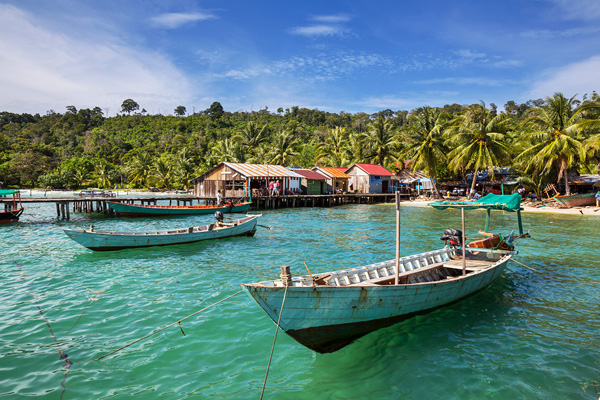
Cambodia
Coastal BeachesCambodia is a Southeast Asian nation located on the Indochinese Peninsula, bordered by Thailand, Laos, and Vietnam, with a coastline along the Gulf of Thailand. The country is home to the Khmer people and their rich cultural heritage, most famously exemplified by the temples of Angkor Wat. The economy is primarily based on agriculture, tourism, garment manufacturing, and fishing, with rapid development in recent decades. Cambodia offers a blend of ancient history, vibrant Buddhist traditions, and modern urban centers like Phnom Penh. The is significantly lower than Western countries, making it attractive to expatriates and digital nomads. Daily life combines traditional Southeast Asian culture with increasing modernization, though infrastructure outside major cities remains developing.
 BlueCross BlueShield Global Solutions
Get Quote
BlueCross BlueShield Global Solutions (BCBS) offers global health plans for international assignments or trips lasting 6 months or longer. With access to over 1.7M medical providers in 190 countries around the world, BCBS provides members with solutions and industry-leading digital services - ensuring top-quality coverage to people who live, work, study and travel internationally.
BlueCross BlueShield Global SolutionsBlueCross BlueShield Global Solutions (BCBS) offers global health plans for international assignments or trips lasting 6 months or longer. With access to over 1.7M medical providers in 190 countries around the world, BCBS provides members with solutions and industry-leading digital services - ensuring top-quality coverage to people who live, work, study and travel internationally.
Get Quote
Podcasts

Episode 8: Jake Barber - The Expat Finance Expert Returns



Episode 6: Jake Barber - Expat Finance Expert and Lifelong Expat
Living in Cambodia
Best Places to Live in Cambodia
Visa & Residency
Obtaining a residency in Cambodia is a process that can be straightforward if the applicant is well-prepared with the necessary documents and understands the requirements. The most common type of visa for expats seeking long-term residency is the Ordinary Visa, also known as the E class visa. Upon arrival in Cambodia, expats can apply for an E class visa directly at the airport or at any other entry point. This visa is initially valid for 30 days and can be extended within the country. To extend the Ordinary Visa, expats must choose from one of the following options: EB Visa for business and employment, EG Visa for those seeking employment or who are in between jobs, ER Visa for retirees, and ES Visa for students. The extension process requires expats to present relevant documentation, such as a letter of employment for the EB Visa or proof of retirement income for the ER Visa. The extensions can be for one, three, six, or twelve months; however, only the six and twelve-month extensions allow for multiple entries. The difficulty of the process largely depends on the type of visa extension an expat applies for. For example, the EB Visa requires a work permit, which involves additional paperwork and a separate application process. On the other hand, the ER Visa for retirees may be less complicated, provided that the applicant can demonstrate sufficient funds or a pension. It is important to note that while the process is manageable, it often requires the assistance of a local agent or agency that specializes in visa services, as they can help navigate the nuances of the Cambodian system. Fees for these services and the visa extensions themselves vary, and it is advisable to budget for these costs. Overall, while there may be some bureaucratic hurdles and the need for proper documentation, the process of obtaining a residency visa in Cambodia is considered average in terms of difficulty. Expats who are prepared and seek local assistance when necessary can successfully obtain residency in Cambodia.
Healthcare in Cambodia
The system in Cambodia is a mix of public and private services. The public healthcare system is under-resourced and faces challenges such as a shortage of trained healthcare professionals and modern equipment. Public hospitals and clinics are available but often lack the quality of care found in private institutions. Private healthcare in Cambodia offers higher standards of care with better facilities and more English-speaking staff, but it is more expensive. The cost of healthcare varies widely; public healthcare is often very affordable but may not meet the needs of more serious medical conditions, while private healthcare can be costly. Expats and digital nomads can access public healthcare, but many opt for private healthcare or travel to neighboring countries for more complex health issues. health insurance is highly recommended for expats and digital nomads to cover the costs of private care or medical evacuation.
Cost of Living
Cambodia has one of the lowest costs of living in Southeast Asia, making it highly affordable for expatriates. Rental housing in Phnom Penh ranges from $300-800 USD monthly for modest apartments to $1,500+ for upscale accommodations, while provincial towns offer significantly cheaper options at $150-400 monthly. Property purchases are available but restricted for foreign nationals; long-term leases are the standard option. Daily expenses including food, transportation, and utilities are very economical, with local meals costing $1-3 USD and overall monthly living expenses for a single person ranging from $800-1,500 USD depending on lifestyle.
Weather
Cambodia experiences a tropical monsoon climate with two main seasons: the southwest monsoon (May to October) brings heavy rainfall and humidity, while the northeast monsoon (November to April) provides drier, cooler conditions. Temperatures remain warm year-round, typically ranging from 20°C to 35°C (68°F to 95°F), with the hottest months being April and May. The rainy season can cause flooding in some areas, particularly in rural regions and near the Mekong River. The dry season (November to February) is considered the most pleasant time to visit or relocate.
Educational System in Cambodia
The educational system in Cambodia has been undergoing reforms to improve its quality and accessibility. Education is compulsory for nine years, which includes six years of primary education (grade 1 to 6) and three years of lower secondary education (grade 7 to 9). Children typically start school at the age of six. After completing lower secondary school, students can choose to continue to upper secondary education (grade 10 to 12) or enroll in vocational training programs. The school year in Cambodia runs from November to August and is divided into two semesters. The curriculum includes Khmer language, mathematics, science, social science, physical education, arts, and foreign languages, with English being increasingly emphasized. Public schools in Cambodia are free, but there are challenges such as overcrowded classrooms, limited resources, and the need for additional support for students to succeed. Private and international schools are also available, offering different curricula and languages of instruction, which may be more suitable for expatriate families. These schools often provide higher quality education but come with higher tuition fees. The government has been working to improve the quality of education by training teachers, updating curricula, and building more schools, especially in rural areas
Living in Cambodia
Healthcare in Cambodia
Best Places to Live in Cambodia
Moving to Cambodia