Brazil
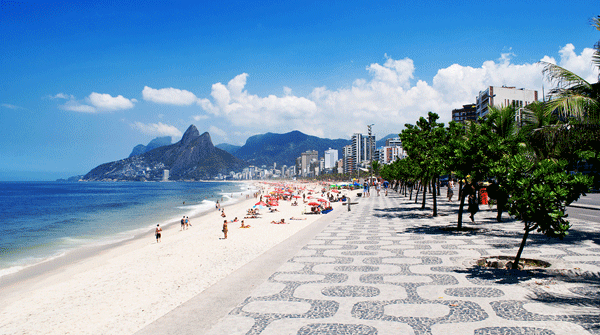
Coastal BeachesBrazil is the largest country in South America, spanning diverse landscapes from the Amazon rainforest to Atlantic coastlines and vast interior plateaus. With a population of over 215 million, it is a vibrant multicultural society shaped by indigenous, African, and European influences reflected in its music, food, and festivals. The economy is one of the world's largest, driven by agriculture, mining, manufacturing, and services, though regional disparities exist. Brazil offers a tropical lifestyle with warm weather year-round, dynamic cities like São Paulo and Rio de Janeiro, and access to natural wonders. The culture is known for its warmth, celebration, and passion, evident in Carnival and daily social interactions. Life in Brazil combines modern urban amenities with natural beauty and a relaxed approach to living.
 Oliveira Lawyers
Get Quote
Oliveira Lawyers is the foremost Brazilian law firm dedicated to representing the interests of foreign citizens in Brazil. From immigration to real estate and other life events, our bilingual attorneys got you covered! Main services include immigration, real estate, notary services, tax services, collections, family law, and litigation.
Oliveira LawyersOliveira Lawyers is the foremost Brazilian law firm dedicated to representing the interests of foreign citizens in Brazil. From immigration to real estate and other life events, our bilingual attorneys got you covered! Main services include immigration, real estate, notary services, tax services, collections, family law, and litigation.
Get Quote
Podcasts

Episode 8: Jake Barber - The Expat Finance Expert Returns



Episode 6: Jake Barber - Expat Finance Expert and Lifelong Expat
Living in Brazil
Best Places to Live in Brazil
Visa & Residency
Obtaining a residency in Brazil involves several steps and can vary in complexity depending on the type of visa applied for. The two most common types of visas for expats are the Permanent Visa (VIPER) and the Temporary Visa (VITEM). The Permanent Visa is typically for those who have family ties in Brazil, such as a Brazilian spouse or child, or for those who are retiring in Brazil with a transfer of a sufficient monthly income. The Temporary Visa encompasses various categories, including work, study, and research. For a work visa, the applicant must first secure a job with a Brazilian company, which will sponsor the visa. The company must prove that the position cannot be filled by a local worker. The Temporary Visa for work is usually valid for up to two years and can be converted into a permanent visa after this period. Digital nomads often use the Temporary Visa (VITEM-V), which is intended for artistic or cultural activities, including sports, but can be adapted for remote workers. This visa allows them to live in Brazil for up to one year and can be extended for another year. The application process generally involves submitting various documents, such as a passport, birth certificate, proof of income or employment, and a criminal background check. Applicants must also fill out the appropriate application forms and pay the required fees. Some visas require registration with the Federal Police in Brazil within 90 days of arrival. The difficulty of the process can vary. It is considered average, but it can be challenging due to bureaucratic hurdles and the need for proper documentation and sponsorship. It is highly recommended to consult with the Brazilian consulate or embassy in the applicant's home country, as well as potentially hiring a legal representative or specialist to assist with the process. The exact requirements and procedures can change, so up-to-date information should be sought during the application process.
Healthcare in Brazil
The healthcare system in Brazil is a complex mix of public and private services. The public system, known as the Unified Health System (Sistema Único de Saúde, SUS), provides healthcare services to the entire population free of charge. It is funded by taxes and is the largest system of this type in the world. However, due to underfunding and mismanagement, the quality of public healthcare can vary greatly, with long waiting times and sometimes substandard conditions in overcrowded hospitals. In contrast, the private healthcare sector offers high-quality services with more modern facilities and shorter waiting times, but at a cost that can be prohibitive for many Brazilians. Expats and digital nomads can access public healthcare by registering with the SUS and obtaining a Brazilian taxpayer registry number (CPF). However, many expats choose to use private healthcare due to its higher quality and efficiency.
Cost of Living
Brazil offers relatively affordable living compared to North America and Western Europe, though costs vary significantly by region and city. In major cities like São Paulo and Rio de Janeiro, monthly rent for a one-bedroom apartment in central areas ranges from $400-800 USD, while outside city centers it can be $250-500 USD. Property purchases average $3,000-6,000 USD per square meter in prime locations, considerably less in secondary cities. Daily expenses including food, transportation, and utilities are generally low, making Brazil accessible for many budgets, though imported goods and luxury items carry premium prices.
Weather
Brazil experiences tropical and subtropical weather patterns with warm temperatures throughout most of the year. The rainy season typically occurs from December to March in the south and southeast, while the north experiences rainfall year-round due to Amazon influence. Temperatures generally range from 20-30°C (68-86°F) depending on region and season, with cooler temperatures in southern areas during winter months (June-August). Humidity levels are often high, particularly in coastal and rainforest areas.
Educational System in Brazil
The educational system in Brazil is structured in several levels, starting with preschool education (Educação Infantil) for children up to 5 years old. Following this, students enter fundamental education (Ensino Fundamental), which is mandatory and divided into two stages: the first stage covers grades 1 to 5 (ages 6 to 10), and the second stage covers grades 6 to 9 (ages 11 to 14). After completing Ensino Fundamental, students progress to secondary education (Ensino Médio), which lasts for three years, typically from ages 15 to 17. This stage prepares students for higher education and culminates in a national high school exam (ENEM), which is used for university admissions. The Brazilian educational system has faced challenges, including disparities in quality and access, but there are also prestigious schools, particularly in urban areas. Public education is free at all levels, and the country has been working to improve educational standards and increase school attendance. For families moving to Brazil, it's important to note that while public schools do not charge tuition, many opt for private schools seeking better quality education. The academic year usually starts in February or March and ends in November or December, with a break in July.
Living in Brazil
Healthcare in Brazil
Best Places to Live in Brazil
Moving to Brazil