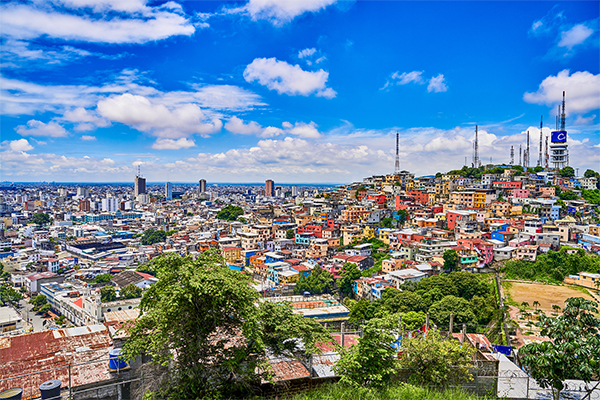
Guayaquil
Urban Coastal RiverfrontGuayaquil is the largest city in Ecuador and serves as the country's primary economic and commercial hub. Located on the western coast of South America, it is a vibrant metropolis characterized by its bustling port, which is one of the most important in the region. The city sits along the Guayas River, which has historically been central to its development and trade. Guayaquil features a mix of modern high-rise buildings, colonial architecture, and residential neighborhoods. The city is known for its lively atmosphere, with numerous restaurants, markets, and cultural venues. The Malecón 2000, a waterfront promenade, is a major attraction offering parks, museums, and entertainment options. Guayaquil experiences significant urban development and serves as a gateway for trade throughout Ecuador and the broader Pacific region. The city has a tropical setting with diverse neighborhoods ranging from upscale areas to more modest residential zones. Despite challenges common to large urban centers, Guayaquil remains a dynamic and important city in South America.
 AGS Worldwide Movers
Get Quote
Relocating abroad soon? Make your move with AGS! AGS Worldwide Movers is a leader in the international moving industry. Our experience and expertise allows us to guarantee our clients the best quality moving services.
AGS Worldwide MoversRelocating abroad soon? Make your move with AGS! AGS Worldwide Movers is a leader in the international moving industry. Our experience and expertise allows us to guarantee our clients the best quality moving services.
Get Quote
Visa & Residency
Obtaining a residency in Ecuador is a process that can be straightforward if the applicant has all the required documentation and meets the specific criteria for the visa category they are applying for. There are several types of residency visas available, each catering to different needs and circumstances. The Pensioner Visa (9-I) is popular among retirees who can prove a stable income from a pension or retirement benefit. The minimum income requirement is typically around $800 per month for a single applicant, with an additional $100 for each dependent. This visa grants the holder permanent residency. Another common option is the Professional Visa (9-V), which is designed for individuals with a recognized university degree. Applicants must have their degree apostilled or legalized, depending on their country of origin, and it must be recognized by the Ecuadorian authorities. For digital nomads and those looking to stay in Ecuador for a shorter period, the Temporary Resident Visa is a suitable option. This visa allows individuals to live in Ecuador for up to two years and can be extended. It is important to note that while holding this visa, one cannot be absent from Ecuador for more than 90 days per year. The process of obtaining a residency visa generally involves gathering necessary documents such as a passport, police background check, and proof of income or health insurance. All documents must be apostilled or legalized and translated into Spanish. The applicant must then submit these documents to the Ecuadorian consulate in their home country or directly to the Ministry of Foreign Affairs and Human Mobility in Ecuador. Once the application is submitted, the processing time can vary, but it generally takes a few months. It is advisable to work with a legal representative or visa agent in Ecuador to ensure that the process goes smoothly, as they can provide up-to-date information on the requirements and help navigate any bureaucratic hurdles. Overall, while the process can be involved, it is considered average in terms of difficulty compared to other countries. Successful applicants will receive a visa that allows them to enjoy the benefits of living in Ecuador, including access to its healthcare system and the ability to apply for citizenship after a certain period of residency.
Cost of Living
The cost of living in Guayaquil is moderate compared to many international cities, though it varies significantly by neighborhood and lifestyle. Housing, food, and transportation are generally affordable, particularly in local markets and residential areas away from the city center. Expats and those seeking modern amenities may find costs higher in upscale neighborhoods.
Weather
Guayaquil has a tropical climate with warm temperatures year-round and a rainy season from January to April, with relatively drier conditions from May to December.
Healthcare in Guayaquil
Guayaquil has several private hospitals and clinics that meet international standards, including Hospital Clínica Kennedy and Hospital Metropolitano, which cater to both locals and expats. Public healthcare facilities exist but are often overcrowded, so many expats opt for private medical services. Healthcare quality varies, with private institutions offering modern equipment and English-speaking staff.
Schools in Guayaquil
Guayaquil has several international schools including Colegio Americano de Guayaquil (American curriculum), Colegio Británico (British curriculum), and Colegio Alemán Humboldt (German curriculum). These schools offer IB programs and follow international educational standards.
Multiple bilingual schools operate in Guayaquil, offering Spanish-English instruction at various levels. These schools combine local and international curricula to develop bilingual competency in students.
Restaurants in Guayaquil
Living in Guayaquil
Moving to Guayaquil
Healthcare in Guayaquil