Bologna
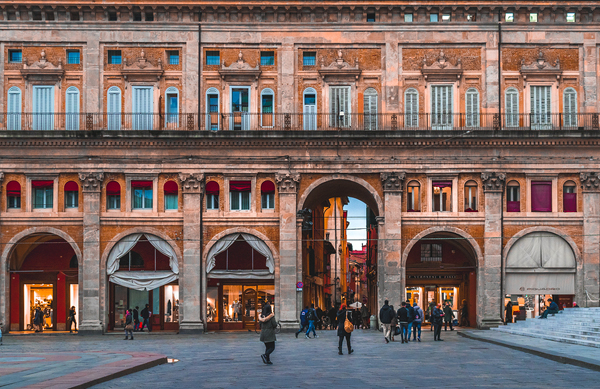
Urban RiverfrontBologna draws students, young professionals, and families seeking an authentic Italian city experience without the tourist crush of Rome or Florence. The city's identity centers on its medieval towers, Renaissance palaces, and a university founded in 1088—one of Europe's oldest. The Porticoes of Bologna, a UNESCO World Heritage site, form an extraordinary network of covered walkways stretching over 40 kilometers, allowing residents to move through the city sheltered from rain and sun. The food culture is legendary: this is where tortellini, mortadella, and Bolognese sauce originate, and the central market and trattorias reflect a serious commitment to eating well. The historic center is compact and walkable, with the Piazza Maggiore serving as the social and civic heart. Beyond the medieval core, neighborhoods like Santo Stefano and San Vitale offer quieter residential character while remaining close to everything. The city has a working, lived-in quality—not a museum piece—with students and locals filling the streets, bars, and markets year-round.
 Italian For A While
Connect
Become ‘Italian for a While’ with IFA! Learn in Italy on a 1-week to 12-month program - open to students, young adults, graduates, digital nomads, professionals, groups, faculty-led programs, and more. Take courses at an accredited school while immersing yourself in the language, life, and culture among your international peers. Submit an inquiry with IFA to learn more.
Click connect to have our partner contact you via e-mail and/or phone.
Italian For A WhileBecome ‘Italian for a While’ with IFA! Learn in Italy on a 1-week to 12-month program - open to students, young adults, graduates, digital nomads, professionals, groups, faculty-led programs, and more. Take courses at an accredited school while immersing yourself in the language, life, and culture among your international peers. Submit an inquiry with IFA to learn more.
Connect
Click connect to have our partner contact you via e-mail and/or phone.
Visa & Residency
Obtaining a residency in Italy involves several steps and the process can vary depending on the type of visa you are applying for. The most common types of visas for expats include the Elective Residence Visa and the Work Visa. The Elective Residence Visa is designed for individuals who can prove they have a high, steady income from sources outside of Italy and do not need to work in the country. Applicants must show they have sufficient funds to support themselves, a place to live, and comprehensive health insurance. This visa is valid for one year and can be renewed. The Work Visa is for those who have secured a job in Italy before entering the country. The employer must apply for a work permit on behalf of the employee, which is subject to quotas. Once the work permit is granted, the employee can apply for the visa. This process can be quite competitive and time-consuming due to the quota system. Other visas include the Student Visa and Family Reunification Visa. The process generally involves gathering the required documentation, such as a valid passport, proof of financial means, accommodation, and health insurance, and submitting an application to the Italian consulate or embassy in your home country. An appointment is usually required, and you may need to attend an interview. The difficulty of the process can vary; it is often described as average, but it can be challenging due to the bureaucracy and strict requirements. It is advisable to start the application process well in advance of your intended move date and to seek assistance from professionals if necessary. Once in Italy, you will need to apply for a residence permit (permesso di soggiorno) within eight days of arrival to stay legally. This additional step involves going to the local post office or police station (Questura) to submit the necessary paperwork. Overall, while the process can be bureaucratic and requires careful preparation, it is manageable with the right planning and support.
Cost of Living
Living in Bologna costs considerably less than Milan or Rome, making it accessible for students and young professionals while remaining affordable for families. Rent for a one-bedroom apartment in the center runs well below northern European cities, and groceries, dining out, and utilities are reasonable. Property purchase prices have risen in recent years as the city's appeal has grown, but remain moderate compared to major Italian metros.
Weather
Bologna experiences a humid continental climate with cold, damp winters (temperatures often near freezing) and warm, sometimes hot summers. Spring and autumn are mild and pleasant, though fog can settle over the Po Valley in winter months.
Healthcare in Bologna
Ospedale Sant'Orsola-Malpighi, the city's primary teaching hospital affiliated with the University of Bologna, handles complex cases and trauma. Public healthcare through the Emilia-Romagna regional system covers residents; private clinics including Clinica Privata Villalba offer alternatives. Wait times for non-emergency procedures can extend several months within the public system.
Schools in Bologna
Bologna hosts several international schools including the International School of Bologna, which offers IB programs from primary through secondary levels. The school follows an English-language curriculum and serves expat families across the Emilia-Romagna region.
Bilingual education options exist through private institutions offering Italian-English instruction, though availability is more limited than in larger Italian cities. Several schools integrate bilingual components into their curricula, particularly at the primary level.
Restaurants in Bologna
Living in Bologna
Moving to Bologna
Healthcare in Bologna