

Cabo San Lucas

Mexico > Cabo San Lucas

Cabo San Lucas

Beach   Coastal   Beaches  

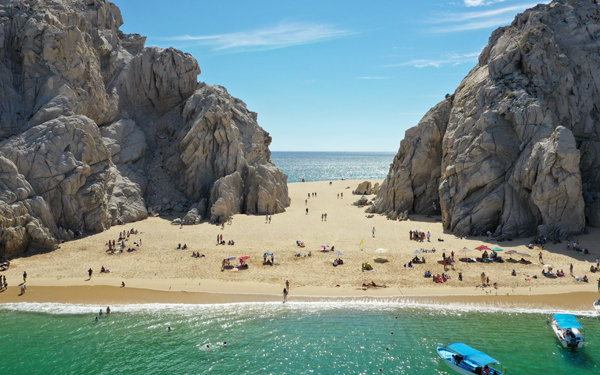
Cabo San Lucas sits at the southern tip of the Baja California Peninsula where the Pacific Ocean meets the Sea of Cortez, a geography that shapes everything about the place. The rhythm here is unhurried despite the resort infrastructure—days revolve around water, whether that means sport fishing, snorkeling, or simply watching the light change across the rocks at Land's End. The town itself is compact and walkable, with a marina district that pulses with activity, restaurants ranging from casual to high-end, and a downtown that feels more lived-in than purely touristic. The surrounding desert landscape is stark and dramatic, meeting the water in ways that feel almost theatrical. Cabo draws visitors year-round, but the atmosphere shifts seasonally—winter brings crowds and higher energy, while summer quiets considerably. The blend of natural spectacle, reliable infrastructure, and accessibility from the United States has made it a destination for decades, though the character remains tied to its fishing heritage and the particular light and geology of this peninsula's end.

SJB GlobalSJB Global
Connect

SJB-Global is a top-rated financial advisory firm specializing in expat financial advice worldwide, offering retirement planning & tax-efficient solutions with a regressive fee model. Our clients benefit from their country’s most favorable tax environment by utilizing the efficient investment vehicles we offer. Our commitment to quality service is reflected in our stellar reviews, with over 300 testimonials boasting 95% five-star ratings.

Click connect to have our partner contact you via e-mail and/or phone.

SJB GlobalSJB Global

SJB-Global is a top-rated financial advisory firm specializing in expat financial advice worldwide, offering retirement planning & tax-efficient solutions with a regressive fee model. Our clients benefit from their country’s most favorable tax environment by utilizing the efficient investment vehicles we offer. Our commitment to quality service is reflected in our stellar reviews, with over 300 testimonials boasting 95% five-star ratings.
Connect

Click connect to have our partner contact you via e-mail and/or phone.

Visa & Residency

Obtaining a residency in Mexico is a process that can be straightforward if the applicant meets the necessary requirements and follows the steps diligently. There are primarily two types of residency visas: the Temporary Resident Visa and the Permanent Resident Visa. The Temporary Resident Visa is suitable for those who wish to stay in Mexico for more than six months but not longer than four years. It is popular among expats who are not yet ready to commit to permanent residency. To apply for this visa, one must visit a Mexican consulate abroad. The applicant will need to provide proof of sufficient economic means to support themselves, or they must show that they are employed or have a job offer in Mexico. The Permanent Resident Visa is for those who intend to settle in Mexico indefinitely and is often sought by retirees or those with family in Mexico. To qualify, applicants must meet stricter financial requirements or have certain family connections with Mexican citizens or other permanent residents. The application process for the Permanent Resident Visa is similar to that of the Temporary Resident Visa, but with additional documentation required to prove the applicant's long-term economic solvency or family ties. The difficulty of the process can vary based on individual circumstances, such as the applicant's nationality, financial situation, and the specific requirements of the Mexican consulate where the application is submitted. Generally, the process is considered average in terms of difficulty when compared to other countries. It is important to note that all documents must be translated into Spanish and apostilled or legalized, depending on the country of origin. Once the visa is approved, the applicant will receive a visa sticker in their passport, which must be exchanged for a resident card within 30 days of entering Mexico at the nearest office (Instituto Nacional de Migración). The process involves submitting various forms, taking photographs, and possibly attending an interview. Overall, while there are several steps to follow, the process is well-documented and can be navigated with patience and careful preparation.

Cost of Living

Prices in Cabo San Lucas reflect its status as a major international resort destination. Accommodations, dining, and entertainment cater to affluent travelers, which drives costs well above Mexican averages. Expats and retirees who settle here typically budget for premium housing and imported goods, though living costs can be managed more moderately if you avoid the tourist-facing establishments and venture into local neighborhoods.

Weather

Cabo San Lucas has a hot desert climate with warm to hot temperatures year-round, though winters (November to March) are mild and pleasant while summers (June to September) are intensely hot and humid with occasional tropical storms.

Healthcare in Cabo San Lucas

Hospital Angeles Los Cabos and Galenia Hospital provide modern facilities with English-speaking staff and equipment comparable to U.S. standards, though both cater primarily to private insurance and out-of-pocket patients. Emergency care is available 24/7, but serious trauma cases sometimes require air evacuation to La Paz or Mexico City. Dental and cosmetic procedures draw medical tourists, inflating wait times during peak season.

Schools in Cabo San Lucas

Cabo San Lucas has several international schools including Cabo San Lucas Private School and American School of Los Cabos, which offer curricula aligned with U.S. or IB standards. These institutions serve the expatriate and affluent Mexican families in the area, though enrollment can be competitive and tuition costs are high.

Bilingual education is standard across most private schools in Cabo San Lucas, with Spanish-English instruction common at institutions serving both local and international families. Public schools operate primarily in Spanish, while private options integrate bilingual programming as a baseline offering.

Restaurants in Cabo San Lucas

Copyright 1997-2026 Burlingame Interactive, Inc.

Privacy Policy Legal