Why Expats Keep Choosing Costa Rica: Stability, Healthcare, and Long-Term Residency


Summary: Costa Rica continues to attract expats for practical reasons: political stability, universal healthcare, established residency pathways, and a predictable framework for daily life. While its beaches and biodiversity get attention, it is structure and long-term viability that keep the country consistently on shortlists.
Costa Rica keeps coming up in expat conversations for practical reasons. It is one of the most politically stable democracies in Latin America, with no standing military and a long history of peaceful transitions of power. That stability directly affects daily life. Public institutions function. Elections are routine. Civil unrest is rare. For expats evaluating long-term residency rather than short-term adventure, this predictability matters.
healthcare is another foundational factor. Costa Rica's universal public healthcare system (Caja) is available to legal residents who contribute monthly based on income. It covers primary care, hospital services, and major procedures. While wait times can vary, serious care is widely regarded as competent and accessible. Private care operates alongside the public system at costs far below those in the United States. Many expats use a blended approach.
You can read more about healthcare in Costa Rica here.
Costs are often misunderstood. Costa Rica is not inexpensive in the way some imagine. Housing in popular beach towns can be high, imported goods are expensive, and certain services are priced with foreigners in mind. However, many expenses remain stable and predictable: property taxes are low, utilities are manageable, and healthcare costs are controlled. Many long-term residents describe it in similar terms: Costa Rica isn't cheap, but it is predictable. Once you understand the system, you can build a real life here.
If you are evaluating budgets, see our detailed guide to the cost of living in Costa Rica.
Residency pathways are well established and widely used. The Pensionado program requires proof of a lifetime pension (commonly $1,000 per month). The Rentista category requires proof of stable income or a bank deposit. The Investor program allows residency through qualifying property or business investment. These categories are clearly defined and have been used for decades.
For a full breakdown of residency options, see our guide to residency in Costa Rica.
Daily life tends to feel informal and relationship-driven. The phrase “pura vida” reflects more than marketing — it signals patience and perspective. Systems function, but not always quickly. Paperwork may require multiple visits. Appointments may move at a slower pace. For some newcomers, especially those from highly standardized systems, this requires adjustment. For others, it feels like relief.
Beach Towns, Mountain Towns, and Regional Choice
One of Costa Rica's defining strengths is its range of lifestyle environments. There is no single dominant expat city. Instead, people choose based on climate, elevation, and proximity to the ocean.
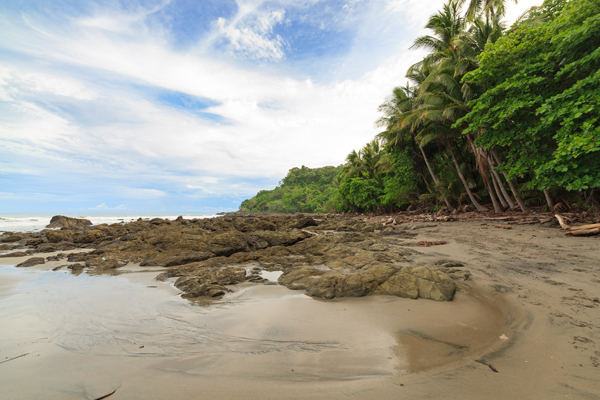
Guanacaste offers drier beach living with established expat communities. The southern Pacific region provides greener jungle-meets-ocean environments. The Central Valley delivers infrastructure, schools, and access to the international airport. Inland areas like Lake Arenal offer cooler mountain air and lake views.
If you want a deeper breakdown of specific communities, see our guide to the 17 best places to Live in Costa Rica, which covers towns such as Playa Flamingo, Nosara, Jaco Beach, Lake Arenal, and Ojochal.
This decentralized structure allows expats to design daily life around personal preference rather than conforming to one national template.
Environmental consciousness is also embedded in national identity. Roughly a quarter of Costa Rica's land is protected. National parks, wildlife corridors, and sustainability policies are mainstream rather than niche. For many expats, daily access to nature becomes part of ordinary life rather than an occasional luxury.
Costa Rica tends to suit retirees, remote workers, and families who value political calm, healthcare access, environmental integration, and steady routines. It may feel less satisfying for those who prioritize high-speed infrastructure, intense urban density, or strict efficiency. Income generation inside the country can require planning, and humidity and seasonal rain require adaptation.
But for many expats, the calculation is straightforward.
Stability. Healthcare. Defined residency. Predictable long-term planning.
There's a reason Costa Rica keeps coming up.
About the Author
 Betsy Burlingame is the Founder and President of Expat Exchange and is one of the Founders of Digital Nomad Exchange. She launched Expat Exchange in 1997 as her Master's thesis project at NYU. Prior to Expat Exchange, Betsy worked at AT&T in International
and Mass Market Marketing. She graduated from Ohio Wesleyan University
with a BA in International Business and German.
Betsy Burlingame is the Founder and President of Expat Exchange and is one of the Founders of Digital Nomad Exchange. She launched Expat Exchange in 1997 as her Master's thesis project at NYU. Prior to Expat Exchange, Betsy worked at AT&T in International
and Mass Market Marketing. She graduated from Ohio Wesleyan University
with a BA in International Business and German.
Some of Betsy's articles include 12 Best Places to Live in Portugal, 7 Best Places to Live in Panama and 12 Things to Know Before Moving to the Dominican Republic. Betsy loves to travel and spend time with her family. Connect with Betsy on LinkedIn.
Additional Information:
- Costa Rica Guide
- Healthcare & Health Insurance in Costa Rica
- Members Talk about Healthcare & Health Insurance in Costa Rica
- Best Places to Live in Costa Rica
- Real Estate in Costa Rica
- Guide to Real Estate in Costa Rica
- Pros & Cons of Living in Costa Rica
- Cost of Living in Costa Rica
- Do I need Health Insurance When Moving to Costa Rica?
- Having a Baby in Costa Rica
- Health Insurance in Costa Rica
- Best Places to Visit in Costa Rica for Christmas Cheer
- 2026 Guide to Living in Costa Rica
- Pros and Cons of Living in Costa Rica 2026
- 2026 Guide to Moving to Costa Rica
- Members Talk about the Cost of Living in Costa Rica