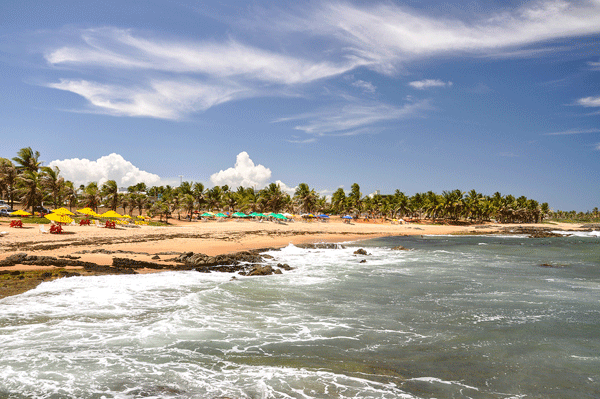
How to Buy a Home in Brazil


Summary: Real Estate Brazil, Homes for Sale in Brazil The one tip that you hear expats living in Brazil repeatedly sharing with newcomers is not to buy a home when you first move to Brazil. Rent for a few months or longer so that you have time to find the right neighborhood. Give yourself time to ensure that Brazil is right for you for the long term. If you've already taken time to do those things and are ready to take the plunge and become a property owner, here are tips about buying a home in Brazil. Seasoned expatriates recommend a cautious approach to newcomers eager to settle down�avoid the rush to purchase property upon arrival. Instead, consider the benefits of renting in Brazil during your initial months. This strategy allows you the flexibility to explore various neighborhoods and truly decide if the local lifestyle aligns with your long-term expectations. Once you've acclimated and are certain that Brazil is your future home, here are tips on how to buy a home in Brazil.
Moving to Brazil can be an exciting adventure, and buying a home can make your stay more permanent and comfortable. However, purchasing property in a foreign country can be complex. This guide will help expats navigate the process of buying a home in Brazil, providing essential information about finding properties, understanding restrictions, working with professionals, and avoiding common pitfalls.
How do I find houses for sale in Brazil?
To find houses for sale in Brazil, you can start by searching online listings on websites like VivaReal, ZAP Imóveis, and Imovelweb. These platforms feature properties from all over the country. Additionally, you can contact real estate agencies (imobiliárias) in your desired area. They often have exclusive listings and can provide personalized assistance. Networking with locals, expats, and checking local classifieds can also uncover hidden gems.
Are there restrictions on foreigners owning property in Brazil?
Brazil is generally welcoming to foreign property buyers, with few restrictions. Foreigners have the same rights as locals when buying urban properties. However, rural properties have some restrictions: foreign individuals can only own rural land up to 50 modules (varying in size by region), and foreign companies can only own rural land if they are established in Brazil and the purchase is for the purpose of the company's main activity. To navigate these restrictions, foreigners can set up a Brazilian company or seek assistance from a legal professional.
Does Brazil have an MLS type system?
Brazil does not have a centralized Multiple Listing Service (MLS) like the one used in the United States. Instead, real estate agencies maintain their own databases of listings. This means you may need to check multiple sources to find the perfect property. Working with a well-connected real estate agent can help you access a wider range of listings.
Do brokers have licenses and how do I know if they are licensed?
Real estate brokers in Brazil must be registered with the Regional Council of Real Estate Brokers (CRECI). You can verify if a broker is licensed by asking for their CRECI registration number and checking it on the official CRECI website. Always work with licensed professionals to ensure a safe and smooth transaction.
What documents are required when buying a home in Brazil?
When buying a home in Brazil, you will need the following documents: a valid passport, a CPF (Cadastro de Pessoas Físicas) number, proof of residence, proof of income, and a marriage certificate (if applicable). For the property itself, you will need the property registration (Matrícula do Imóvel) and a certificate from the local municipality confirming there are no outstanding property taxes (Certidão Negativa de Débitos). A power of attorney (Procuração) may also be required if you are not in Brazil for the entire process.
Do I need a lawyer when buying a home in Brazil?
It is highly recommended to hire a lawyer when buying a home in Brazil. A lawyer will help you understand the legal aspects of the transaction, draft and review contracts, perform due diligence on the property, and ensure a smooth transfer of ownership. The cost of hiring a lawyer varies, but you can expect to pay around 1% to 2% of the property value in legal fees.
Do people typically buy a property with all cash or take out a mortgage?
In Brazil, both cash purchases and mortgages are common. However, foreigners may face higher interest rates and stricter lending criteria when applying for a mortgage. It is essential to research and compare different financing options before making a decision. Consulting with a financial advisor or a Brazilian bank can provide valuable insights into the mortgage process.
Are there inspections that take place, and if so what is that process like?
Property inspections in Brazil are not as standardized as in some other countries. While not mandatory, it is wise to hire a professional inspector (engenheiro ou arquiteto) to assess the property's condition. The inspector will check for structural issues, electrical and plumbing problems, and other potential defects. The process typically involves a visual examination and a written report outlining any issues found.
What are some of the pitfalls to avoid when buying property in Brazil?
Some common pitfalls to avoid when buying property in Brazil include not performing adequate due diligence, falling for too-good-to-be-true deals, and not understanding the legal and financial aspects of the transaction. Be wary of properties with unclear ownership, outstanding debts, or irregularities in the registration. Always work with licensed professionals and seek legal advice to minimize risks.
Expats Talk about Real Estate in Brazil
"The south of Brazil is completely different. I lived in Balneário camboriu for one year and I loved it so much that I decided not to live in Europe and I will live down the south of Brazil. We might live in Balneário camboriu or Floripa or another city. We work online so we can move around until we decide. I can go for walks on my own at night at 9pm, 10pm, 11pm and there's lots of people around. Santa Cararina in general is an amazing place. A lot cheaper than Europe and the US and the conversion rate is better for us right now," said one expat living in Brazil.
"Do lots of research as it is available on line. Include in your research a local attorney who speaks English and is a member of either Briton's legal Bar Association or the ABA in the States. It is always nice when the local attorney is licensed in one of those countries because unethical practices could get them barred. With their membership in one of the Bar Associations there should be available info on whether any complaints have been filed against them in the past. These local attorneys act very much like the Title companies in the States. They do all the research to ensure free and clear property and titles. Make sure that you visit the area and the home to ensure it is what you hoped it to be. I would also recommend staying at least 2 weeks and spend time knowing the area. THE MOVE: moving from the UK or USA is probably not a big deal. However, to get your household goods into Brazil.....well that's another matter. For instance, the USA moving company needs a 3rd party in Brazil to facilitate receiving your container and moving it to your new home. They will need paperwork that to us seems highly unusual and bureaucratic. Brazil is after all a highly bureaucratic place to live and if you haven't lived here then your in for a surprise. One of the documents that I needed was my original boarding pass from the airline that I flew from Miami to Recife. The 3rd party Brazilian company stated that without the boarding pass to prove how I arrived in Brazil then the container could not be received in Brazil (my federally stamped passport and my federally stamped Entry Card does not count). The boarding pass along with a number of other paperwork had to be notarized at one of the local Cartarios and returned to the 3rd party company. It will require several hours of standing in line to get 5 minutes of work completed. If your moving to Brazil this is how they do things and all the complaining from me or you will not change it. With all this said, I will say now that after all the standing in line waiting, jumping through hoops and getting mad, after returning home to our villa and seeing the sunset from our roof top........PRICELESS," wrote a member in Praia de Pipa.
"I am sorry to say that after 14 years in Brazil my advise would be don't move, please reconsider. As my dentist (Brazilian) recently said, "Sao Paulo is a cruel city". I hear his comments with a heavy heart. I have grown to love Brazil but the prices, lack of infrastructure, noise, traffic and now protests and violence have taken their toll," commented one expat who made the move to Sao Paulo.
"Brazil is a very big country, with many beautiful places, all having their advantages and disadvantage. Violence and lack of infrastructure are very common in many big cities. If you are looking for someone safe and well developed, move to Santa Catarina. Florianópolis, Camboriu, Itapema, Porto Belo for example are fantastic places to live. They feel more European, it's safe to live there and the infrastructure is good. Get in contact if I can do more to help," remarked one expat living in Brazil.
"Foreign citizens may own any type or size of urban property in Brazil, and there is no restriction on the amount. However, when buying rural land, a foreign citizen must meet certain size restrictions. The municipality in which the land is located will determine the size allowed. Some registries may also require foreign citizens to obtain a Brazilian ID card known as RNM to allow a new title to be issued on their names. ," wrote Luciano Oliveira from Oliveira Lawyers.
Luciano Oliveira is an attorney licensed in Brazil, Texas, and California. Luciano has worked with hundreds of foreign citizens like you to help them make the most of their plans for Brazil.
Click connect to have our partner, Luciano, contact you via e-mail and/or phone.
Luciano Oliveira is an attorney licensed in Brazil, Texas, and California. Luciano has worked with hundreds of foreign citizens like you to help them make the most of their plans for Brazil.
Click connect to have our partner, Luciano, contact you via e-mail and/or phone.
About the Author
 Joshua Wood, LPC joined Expat Exchange in 2000 and serves as one of its Co-Presidents. He is also one of the Founders of Digital Nomad Exchange. Prior to Expat Exchange, Joshua worked for NBC Cable (MSNBC and CNBC
Primetime). Joshua has a BA from Syracuse and a Master's in Clinical and Counseling Psychology from Fairleigh Dickinson University. Mr. Wood is also a licensed counselor and psychotherapist.
Joshua Wood, LPC joined Expat Exchange in 2000 and serves as one of its Co-Presidents. He is also one of the Founders of Digital Nomad Exchange. Prior to Expat Exchange, Joshua worked for NBC Cable (MSNBC and CNBC
Primetime). Joshua has a BA from Syracuse and a Master's in Clinical and Counseling Psychology from Fairleigh Dickinson University. Mr. Wood is also a licensed counselor and psychotherapist.
Some of Joshua's articles include Pros and Cons of Living in Portugal, 10 Best Places to Live in Ireland and Pros and Cons of Living in Uruguay. Connect with Joshua on LinkedIn.
Additional Information:
- Brazil Guide
- Healthcare & Health Insurance in Brazil
- Members Talk about Healthcare & Health Insurance in Brazil
- Best Places to Live in Brazil
- Real Estate in Brazil
- Guide to Real Estate in Brazil
- Pros & Cons of Living in Brazil
- Cost of Living in Brazil
- Do I need Health Insurance When Moving to Brazil?
- Having a Baby in Brazil
- Health Insurance in Brazil
- Best Places to Visit in Brazil for Christmas Cheer
- 2026 Guide to Living in Brazil
- Pros and Cons of Living in Brazil 2026